What is Real-World Assets?

Broader Distribution Access
Tokenization can make distribution and investor access easier to manage across digital channels, subject to local offering rules and investor restrictions.

Potential Liquidity Tooling
Transferability and liquidity depend on the product design, market structure, and legal constraints rather than arising automatically from token issuance.

Transparency
On-chain records can improve traceability and operational visibility, but investors still need off-chain diligence on the asset and legal structure.
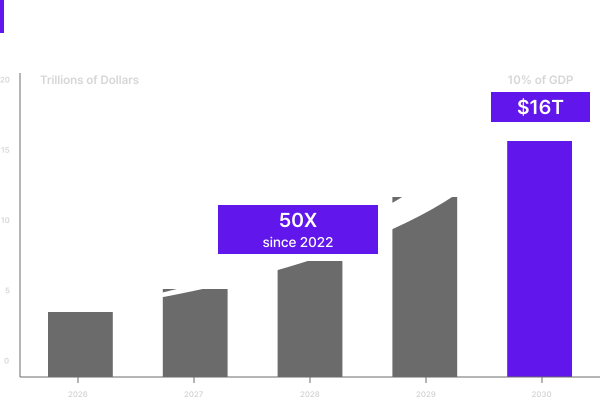
Real-World Asset Markets
Are Growing, But the Category Still Needs Discipline
Market size references are directional context, not evidence that every tokenization model is ready for broad retail deployment.
Current RWA Status

Total RWA Onchain
$30.32B

Tokenized Treasuries
$7.31B

Tokenized Private Credit
$17.08B

Residential Real Estate
$69.28M

Commercial Real Estate
$655.67M
Major Players

AUM
$2B
Cumulative Transactions
$1.5T

Cumulative Transactions
$700B
Source: Tokenization in 2025: Reality Check (The Vault Partners), OnChain U.S. Government Money Fund (FOBXX)
How Digital Investment Has Evolved in South Korea
Traditional Real Estate Investment
Direct Investment
- Rental Management
- Property Management
- Facility Management
- Bank Loan
- Tax Payment
- Accounting Management
- etc
*The owner has to handle everything directly
Indirect Investment (REITs/Fund)
- Securitization of real estate investment rights
- Exchange access depends on product structure and venue
- Lowering entry barriers compared with direct acquisition
- Often oriented toward institutional participation
- 24-hour trading is not possible
- Lack of transparency
- Difficulty in asserting investor rights
*A market primarily focused on institutional investors rather than individuals
Real estate can be costly and illiquid. Tokens can be overly speculative. Regulatory pathways can still be incomplete.
→ WeBlock is structured to address all three cautiously
Digital Real Estate Investment
*The thesis-antithesis-synthesis process is a dialectical method where an idea (thesis 正) is challenged by its opposite (antithesis 反) and resolved by a new, higher idea (synthesis 合).
Online Investment-Linked Finance (P2P)
- Several early online-investment models expanded before regulatory frameworks were fully settled.
- The period highlighted the need for stronger controls, investor protection, and operating discipline.
STO (Securitized Token Offering)
- STO discussion has progressed under tighter supervisory guidance and staged policy development.
- The market remains constrained while rules, infrastructure, and issuance standards continue to mature.
RWA (Real World Asset)
- RWA design benefits from lessons learned across earlier market cycles and policy responses.
- The practical goal is to balance investor protection, legal defensibility, and product innovation.
*The thesis-antithesis-synthesis process is a dialectical method where an idea (thesis 正) is challenged by its opposite (antithesis 反) and resolved by a new, higher idea (synthesis 合).